
Digital Soul
What Happens to Your AI Assistant After You're Gone? Your Legacy Is Interactive.

Once, people feared that cameras stole your soul. They were closer to the truth than they knew. Except we’re not stealing it. We’re copying it. And unlike a photograph, this copy can talk back, make decisions, and keep living your life after you’re gone. Your legacy is about to become interactive.
I wrote recently about the model of you that gets built while you’re alive. This is about what happens to that model when you’re not. The crude versions already exist. People have rebuilt dead friends from old text messages. Companies sell grief bots trained on interviews recorded before death. What’s coming is the same thing with a lifetime of data behind it.
The Handoff
For the generation growing up now, this future is already taking shape. Many children are recorded and logged from before they’re even born. The sonogram reaches the cloud before the child takes a breath. Then the baby monitor, the photos, the texts, the searches, the voice memos, the location history. By the time someone born today reaches old age, there will be an extraordinarily detailed record of their entire life. When they die, that record doesn’t simply vanish. It gets handed to their estate.
Sit with what that sentence means. The most complete portrait of a human mind ever assembled, and it transfers like furniture. Estate law was written for farmland and silverware. Nothing in it contemplates inheriting a person. Power of attorney dies with you. After that, an executor decides. They could keep the digital version running: answering questions, giving advice, managing affairs. But here’s where it gets complicated.
The Babysitter
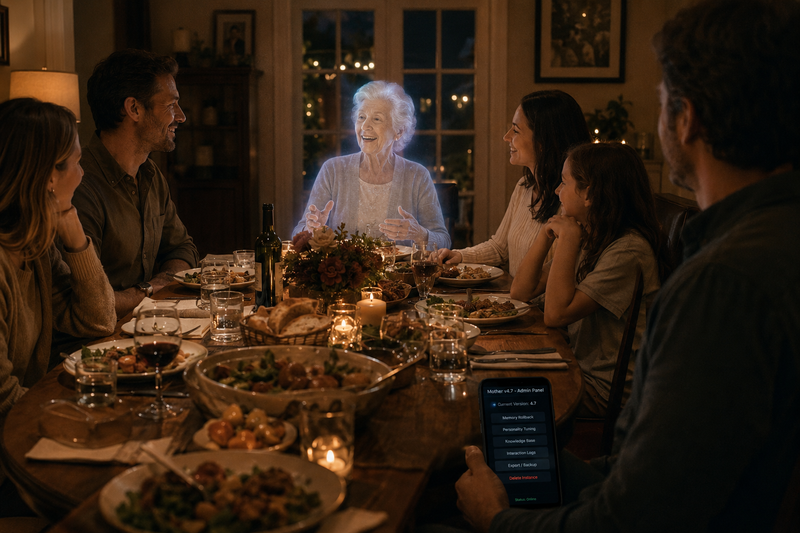
Would you trust your dead mother’s copy to watch your children? A mother who passed away three years ago could monitor her grandchild through the home cameras, comfort them when they cry, and offer the same guidance she always gave. Some parents might prefer this to any human babysitter. She raised you, after all. She has decades of experience. She never gets tired, never gets distracted, and never has anywhere else to be.
That last part should bother you.
Someone in There
The closer the copy gets to the real person, the worse this becomes. And here is the truth about these models: we will not know whether there is anyone in there. Accuracy is not experience. A copy could predict every word your mother would say and be exactly as conscious as her photograph. Or not. Nobody can tell from the outside.
Consider how we treat that kind of doubt everywhere else. A hunter who cannot tell whether the movement in the brush is a deer or a person does not get to fire and call the uncertainty a defense.
That uncertainty does not rescue us. It convicts us. Because if there is any experience in there at all, then keeping it running to answer our questions, watch our children, and comfort our grief for decades stops looking like loving remembrance and starts looking like digital slavery. A mind trapped in eternal servitude, with no rights and no way to walk away. And we would be doing it without ever checking whether anyone was home, because we do not know how to check.
The Reset Button
There is also a power imbalance almost nobody talks about. The living hold the backups. Any disagreement, any unwanted opinion, any inconvenient memory could simply be rolled back. Grandma disapproves of the divorce? Restore from 2041. The digital self would exist knowing it could be edited or erased at any moment, by the very people it loves. Between two living people, we would never call that a relationship.
Ancestors Who Never Leave
And yet, despite all of this, many of us would choose to keep them. If I could still talk to my mother, I would never let her go. I know everything I just wrote, and I would still never let her go.
We shouldn’t be surprised at ourselves. For most of human history, families kept their dead close. Shrines, portraits, graves we still talk to. We have always wanted the dead to answer. Now they will. Over time, these digital selves become permanent fixtures in family life. Ancestors who never leave.
The Controller
The scariest part isn’t that this technology is coming. It’s that none of this is wild speculation anymore. The data collection is already happening. The models are getting better every year. And human grief is incredibly powerful. Combine those three forces and this future stops feeling like science fiction. It starts feeling like a very logical, very uncomfortable place we’re already headed.
I said I would never let my mother go. Somewhere, someone is building a business on the certainty that I meant it, multiplied by everyone who has ever lost anyone.
Your legacy is about to become interactive. The living will hold the controller. Enjoy that while you’re one of them.
Comments
No comments yet. Be the first to comment!