

Insert Token
Are We in a Simulation? That Was Always a Question About Cost. Click to Enter Sim.
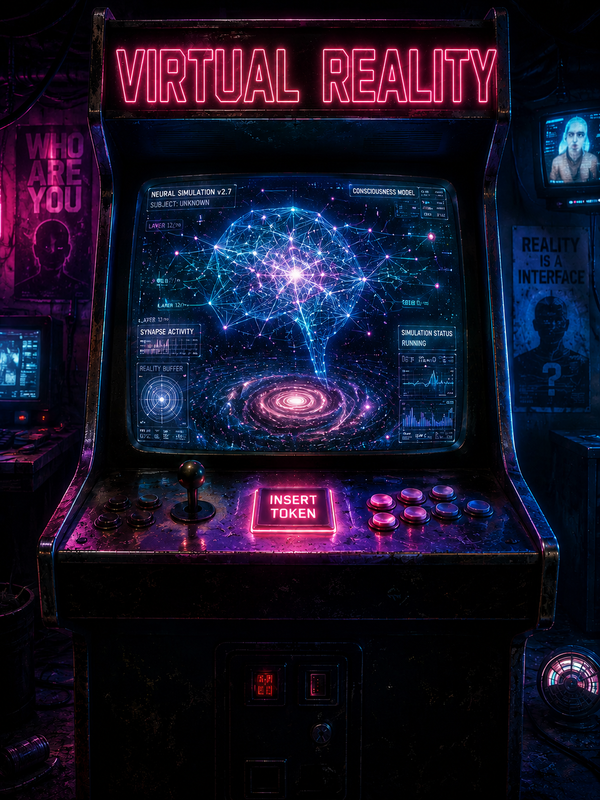

The Simulation Trilemma
Nick Bostrom’s 2003 argument is well known by now. He laid out a simple trilemma: either almost every civilization destroys itself before it reaches a “posthuman” stage capable of running high-fidelity ancestor simulations, or posthuman civilizations almost never choose to run such simulations, or we are almost certainly living in one. The logic is hard to escape once you accept the premises. The only real escape hatch has always been the assumption that these simulations would be astronomically expensive to run at scale.
That assumption is quietly collapsing.
The Power of Templates
In “A Model of You,” I argued that companies and researchers won’t need to build a full, unique model for every individual. They’ll build one general template of human behavior, language, emotions, decision patterns, social habits, and the basic machinery of a mind, and then only record the small differences that actually make you you. Your quirks. Your triggers. Your exceptions. The expensive part gets done once. You become a thin layer of adjustments on top of something that already exists.
The Equation of Meaning
That idea alone changes the economics dramatically. But it becomes even more powerful when you connect it to the direction I explored in “The Equation of Meaning.”
Today’s AI systems brute-force their way to capability. They throw more data, more parameters, and more energy at the problem because they lack an explicit model of how meaning itself works. They rediscover the same underlying patterns over and over again through sheer statistical repetition. That’s the brute-force tax.
If meaning has a deeper, partially mathematical structure and we can move from brute-force approximation to something more like semantic compression, then the shared human template doesn’t just get built once. It gets smaller. The foundational patterns of how minds work, how context shifts meaning, how implication and emotion layer on top of language, all become compressible. Instead of every simulated person needing to re-learn the basic grammar of reality from scratch, that grammar can be expressed more directly and reused across millions or billions of instances.
Shared Storage
In a simulation, you don’t need to duplicate the laws of physics, the geography of Earth, the broad sweep of history, or the cultural background for every single person. Those things live in one master layer that everyone references. Each individual simulation only has to track the deltas, the specific choices, memories, relationships, and internal states that diverge from the baseline. It’s the same principle as video games that only render the part of the world the player is currently looking at, except applied to minds and meaning instead of polygons.
Why This Changes Everything
Put these three things together: a compressible model of meaning, a shared human template plus lightweight personal deltas, and one master copy of base reality. Then the marginal cost of simulating another conscious person drops far faster than most people assume.
At that point, Bostrom’s trilemma stops being abstract. If posthuman civilizations exist and are even mildly interested in their own history, they will generate vastly more simulated minds than there are biological ones. The numbers tilt hard.
We don’t have to decide today whether we’re simulated. But the direction of the technology makes one of those possibilities increasingly expensive to maintain as the default assumption.
The door is still open. It’s just getting harder to pretend the room on the other side is empty.

Comments
No comments yet. Be the first to comment!