

Do You Speak English?
A designed language is coming. Today's languages are tomorrow's Latin.
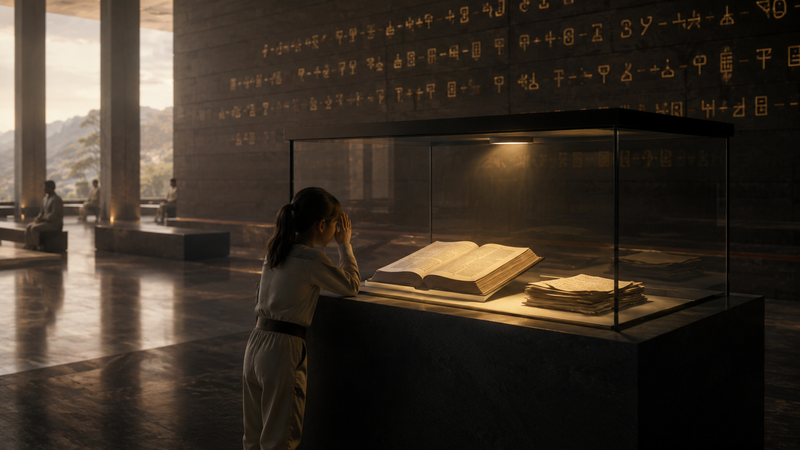

Do you speak English?
Right now it's one of the most useful questions on Earth. It opens borders, jobs, airports, and most of the internet. Give it a century and it may sound the way "do you keep a horse?" sounds now, with cars everywhere. A question about a way of life that quietly became a hobby.
Not because English loses to Mandarin or Spanish. Because the tournament ends.
Nobody Designed This
Language feels like the most human thing we have, so it's easy to forget what it actually is. The oldest unfinished project we run. Nobody designed it. It accumulated. Signals became grammar. Grammar picked up exceptions the way a hull picks up barnacles. Every generation inherited the pile and added to it.
You paid tuition for this. Years of childhood on irregular verbs and spelling that lies about pronunciation. And you pay a running cost every day that is easier to miss. Every sentence you speak is lossy compression. You squeeze a thought into words, transmit, and hope the person on the other end decompresses it into something close. Then you watch their face to check. Ambiguity, redundancy, context, tone repair. The interpretive overhead is constant, and you've been paying it so long you can't feel it.
For most of history that was a fine deal. Approximate and fast beats precise and slow when the message is "run." But the trade-offs of a survival tool become the liabilities of a thinking tool. We're now routing science, law, and every complicated thought we have through an interface optimized for shouting across a field.
The Graveyard
People noticed. The designed-language idea is old, and the graveyard is full.
Esperanto is the most successful invented language in history. Nearly 140 years old, with fewer native speakers than a small town. Lojban was engineered from predicate logic to kill ambiguity outright. It mostly killed conversation. Ithkuil was built for maximum precision in minimum syllables, and it's so demanding that nobody speaks it fluently, including the man who spent decades building it.
The failures rhyme. Each was designed by human minds that couldn't see outside their own linguistic habits. Esperanto is basically Europe in a trench coat. Each demanded a total switching cost for a marginal payoff. Relearn everything to say the same things slightly tidier. And each hit the problem no amount of quality can solve. A language is only worth what its other speakers are worth, and on day one there aren't any.
Easy conclusion: designed languages lose. Real conclusion: designed languages lose as languages. Watch what happens when you narrow the job.
The Ones That Won
Algebra used to be written in sentences. "A square and ten roots equal thirty-nine units." That's how problems looked for centuries, prose all the way down. Then symbolic notation arrived, and within a couple of generations no working mathematician ever went back. Chemistry did the same thing to alchemy's paragraphs. Music got the staff. Circuits got diagrams. Code got programming languages, and nobody writes a loop as an English paragraph.
Every one of those is a designed language that displaced natural language completely inside its domain, and nobody mourned. Not because they were pretty. Because inside the domain, they were simply better interfaces for the thought.
The winners stayed small for one reason. We only knew how to build notation for the easy parts. Quantity, molecule, pitch, logic. The rest of meaning (intent, nuance, causality, the everyday soup) never had a map. So natural language kept that territory by default. Not because it's good there. Because nothing else could hold it.
What Changes
Here's the gate this whole piece runs through.
Someone has to actually map meaning. Not vibes about meaning. A working model. The way we eventually got working models of quantity and pitch. Today's AI doesn't have one. It brute-forces meaning statistically, at staggering cost. That cost is itself evidence the map doesn't exist yet. Everything downstream of this paragraph is conditional on that map getting drawn, by us or by something smarter than us.
But if it gets drawn, language becomes an engineering problem for the first time. And the designer isn't a nineteenth-century idealist working inside his own habits. A system that can model meaning itself, and model the human mind alongside it, can do what Esperanto couldn't. Fit the language to the mind that has to live in it, which is yours.
The map alone isn't the language. A map of meaning could just as easily produce machine code, or a notation only software ever reads. The language is what happens when the map gets filtered through the second model, the one of you: what your ears can parse, your memory can hold, your mouth can say at speed. Meaning supplies the territory. The mind sets the border. The language is the interface drawn between them.
The payoff isn't speed of communication with machines. The payoff is what happens inside your own head. A cleaner interface reduces cognitive load. Less mental effort spent decoding and repairing meaning. More mental effort available for actual thinking. Studies on language already show that grammatical structures affect perception, memory, and even bias. Some forms of expression demand more brain activity than others. A language built from the ground up for the way minds actually work could lower that baseline cost across the board.
It would also reduce friction between people who currently route through translation. Borders, negotiations, and coordination all carry a hidden tax of miscommunication and partial understanding. A single optimized language doesn't erase culture. It removes one layer of noise that currently sits between cultures.
Lower ambiguity where you want precision. Less decoding overhead. A shorter path between the thought and the transmission of the thought. Not a universal translator, which just shuttles between old interfaces. A better interface.
A few natural languages already force you to mark how you know a thing before you can say it. Now imagine slots like that wherever the thought needs one: how sure you are, what it depends on, what would prove you wrong. What English scatters across a paragraph and three footnotes, carried in the sentence itself.
No Second Launch
The obvious objection: couldn't humans just build it themselves? Probably, eventually, a rough version. The graveyard proves we can construct languages; construction was never the wall. The wall is that this is a ship-once problem, and ship-once is the one design regime humans are bad at.
Iteration is our whole method. Drafts, patches, recalls, version numbers: it's how we got everything from the airplane to the operating system. But you can't iterate a language on a live population. Esperanto tried exactly once: a reform movement called Ido split off to fix its flaws. The patch didn't improve the language. It forked the community and weakened both halves. Python's version 3 broke just enough of version 2 that professional programmers, people paid to adapt, needed over a decade to migrate. Now imagine pushing a breaking change to the medium a billion people think in.
A universal language doesn't get a second launch. Surface can drift; vocabulary patches itself the way slang always has. The core can't. Every structural flaw discovered after adoption becomes a permanent barnacle or a fork, and the graveyard already showed what forks do. So the designer has to find the mistakes before anyone learns a word: exhaust the errors in the model instead of on the population. A million design choices, tested against a working map of meaning and a working map of the minds that have to carry it. That's not a job description for a committee of linguists. It's a job description for the thing that has the maps.
The Bootstrap
The graveyard's third problem was always the fatal one. No first speakers. Here's what's different now, and it's the part almost nobody prices in. The first speaker doesn't have to be a person.
You wouldn't learn the new language to talk to strangers. You'd learn it because it lets you think with less drag. The machines would simply be fluent on day one. A billion patient native speakers who never get tired of correcting you, pre-installed in every device you own. That solves the adoption problem that killed every previous attempt. But the real reason to switch isn't the machines. It's the reduction in mental effort and the sharpening of thought that becomes possible once the interface stops fighting you.
The Fog Is a Feature
Here's the part a naive designer would get wrong, and the real one won't.
Ambiguity isn't only overhead. It's where half of being human happens to live. Poetry runs on words meaning two things at once. Jokes run on the swerve. Politeness runs on saying less than you mean, and diplomacy runs on both sides hearing what they need to. "We should get coffee sometime" is load-bearing fog. Everyone knows. Nobody's embarrassed. A language with no slack has no white lies. And a society with no white lies isn't obviously an upgrade.
A designer that actually understands meaning understands this too. That's the difference between compressing language and engineering it. The goal was never maximum precision everywhere; that was Ithkuil's mistake, and nobody can speak Ithkuil. The goal is precision where precision serves you and slack where slack does. Some of the old effort is load-bearing in ways nobody has fully mapped. That's exactly why the careful version removes friction like a surgeon and not like a flood.
The same test runs inside your own head. Not all the friction is waste; some of it is the workout. Hunting for the right word is sometimes how the thought finishes forming, and decoding someone else is how you practice standing where they stand. So the designer has to tell the gym from the tax, and cut only the tax. Get it wrong and the language becomes an exoskeleton doing your lifting. Get it right and it's a gym: load where load builds you, none where it just slows you down.
So the likely shape isn't replacement. It's the split we already run everywhere else. The precise tool for the precise domains. The warm one for the human ones. You calculate in notation and flirt in English. For a while.
Tomorrow's Latin
Latin has run this experiment for us. It didn't die by decree. It got displaced one domain at a time. The markets, the courts, the sermons, and last of all, slowest of all, the science. Newton wrote the Principia in Latin in 1687 because that is where serious thought lived. A century later, serious thought had mostly moved out. Latin kept the ceremonies and the mottos, then became a subject. Something you study, taught by people called classicists. Precious and past.
That's the trajectory for today's languages, English included. And the timeline is generations, not product cycles. The kitchens hold out longest. So do the songs, the arguments, the grief. The emotional registers move last, because they're the ones where the fog is the feature. Your great-grandchildren might pray, curse, and sing in English long after they've stopped doing physics in it. And the scholars who still read today's tongues fluently won't be called polyglots. They'll be something closer to archaeologists. And they'll be right.
The strangest part is who wins the last round. English is on track to take the whole tournament. The first language most of the species can route through. It would finally win right as the category retires. Undisputed champion of the old interface.
None of this arrives on a schedule you'll feel. Displacement never does. It goes the way it went for Latin and for the horse. Domain by domain, each move sensible, no funeral, until one day the old thing is beloved, preserved, and optional.
People still keep horses. Nobody around these parts commutes on one. We'll still keep English as a second language, the way Welsh is kept in Wales. We'll speak it for tradition and heritage. We just won't think in it.

Comments
No comments yet. Be the first to comment!