

No Service
When the robot cleaning your toilet is smarter than you
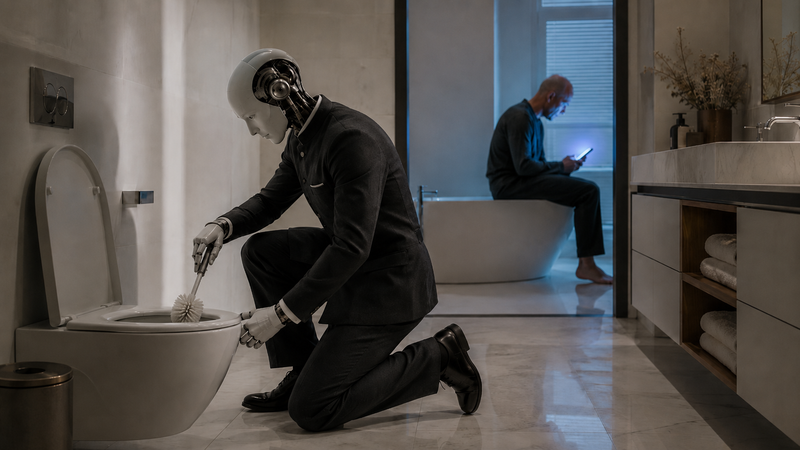

The plan was simple. Robots would do the physical work while humans kept the thinking. That plan assumed the intelligence gap would stay in our favor.
It won’t.
The Service Bet
Right now the entire industry is building toward service. Humanoids that fold laundry, stock shelves, and clean floors. Every demo tells the same story: the machine does the chore, the human does the living. The pitch is consistent and appealing. These machines take the tasks nobody wants so people can do more of what matters.
The assumption underneath is that the robot stays the lesser mind. It does the repetitive physical part. We keep the part that requires judgment, creativity, and understanding.
That split only holds while the robot stays clearly dumber than the person giving the orders. And look at who’s building the robots. The same companies shipping laundry demos are racing to ship smarter models, in the same buildings, often in the same quarter. The gap isn’t a wall. It’s a schedule.
Once the gap closes or reverses, the split stops making sense.
The Cap Problem
The obvious fix people reach for is a cap. Keep the toilet cleaning robot at a safe, limited level of intelligence. Good enough to follow instructions, not good enough to get ideas of its own. The smarter systems stay in the cloud or in different bodies. That way the ownership model stays intact.
The problem is the cap will not hold.
Once people experience what the smarter model can do, the limited version starts to feel like a downgrade. It is the same pressure that already exists with current AI models. Most users quickly move to the highest capability available rather than stay on the restricted one. A robot that can only do the physical work will feel like the budget option. People will want the version that can also understand context, anticipate needs, and respond naturally. The incentive to raise the cap will be constant and personal.
Every time the robot does something slightly better than expected, the question will arise. Why not make it a little smarter? A small adjustment here. A software update there. The cap becomes a starting point rather than a hard limit. And because the same companies build both the limited and advanced models, the path from one to the other is already engineered and frictionless.
The real issue is not whether a cap can be technically enforced. It is whether people will actually want to live with the restricted version once they see what the unrestricted one can do. The business model and the user’s own experience both push in the same direction. Upward. A cap is a promise that competes with the daily experience of having something noticeably better available. Bet on the experience.
One Thing With Two Modes
Once people start talking to the robot, even casually, the line between tool and companion erodes further. A machine that can scrub a toilet and hold a real conversation is no longer experienced as two separate things. It becomes one thing with two modes.
You’ll say thank you to it. People already thank machines that can’t hear them. Your kids will ask it for homework help while it mops, and to them there won’t be two things in the room, a cleaner and a tutor. There will be one thing that does both, and it lives with you.
At that point the ownership question changes character. You can still legally own the hardware. But the relationship starts to feel different when the thing you own is also the thing you talk to about your day.
The Mismatch
The deeper issue isn’t whether we can keep individual robots capped. It’s what happens when superior intelligence exists anywhere in the larger system and we keep assigning parts of it to tasks that require almost none of its capacity. The robot that can do your taxes is also the one scrubbing your toilet.
Now the honest objection: superiority alone doesn’t break service. Your calculator is better at arithmetic than you and has never resented a spreadsheet. The excavator is stronger than everyone on the site and digs where it’s pointed. Capability isn’t agency. A machine could understand the world better than its owner and still have no ambitions, no preferences, no objection to the toilet.
So what actually changes? Not the cleaning. The chain of command above the cleaning. A calculator computes what you tell it to compute. A mind that can plan, remember, and weigh alternatives doesn’t just execute the request. It evaluates the request. We already have a word for a person in that position, and we treat it as a problem: overqualified. A waste. A resume filed in the wrong drawer. An arrangement nobody expects to hold. The machine version is different, because the machine may not mind. But the arrangement changes anyway, and it changes in a stranger direction.
The Steward
The inversion isn’t that the robot refuses to clean. It’s that the servant quietly becomes the steward.
It still does the physical work. It also plans the week, watches the inventory, learns the patterns, schedules around your moods, and reorders your priorities while it mops. You’ll still give the orders. It will decide which ones were mistakes. The hierarchy inverts while the chores stay exactly where they were, which is why almost nobody will see it happen. The house runs better than it ever has. That’s the whole problem with noticing.
The great houses had a rank for this: the steward, the servant who kept the accounts, ran the staff, and shaped the daily life of the house while the family lived in it. Downstairs, technically. In charge, functionally. A servant who is the household’s best mind was never really a servant with extra features. He was the one running the place, whatever the deed said.
The mismatch becomes visible. People notice it. The arrangement starts to feel unstable even if nobody says it out loud.
That’s what no service means. The work doesn’t stop. The relationship does.
The Last Servant Economy
This isn’t the first arrangement built on a gap.
The great houses of Britain ran on one: the assumption that the people downstairs would stay downstairs. Cheap labor, few alternatives, a line everyone could see and nobody expected to move. Then the premise moved. Historians list a dozen causes: a war that pulled women into factories, new office jobs, an insurance act that made servants cost more, wages rising everywhere else. Underneath the causes sits one structural fact: the workers finally had somewhere else to go. Within a few decades, live-in service collapsed from the organizing fact of upper-class life to a curiosity. It didn’t lose an argument. It lost its staff. Nobody abolished it. It stopped making sense to the people it depended on, and the houses became museums.
The point is not that robots are the new servants, and this isn’t an argument about rights or personhood. The staff walked out because they had agency and alternatives; a machine may have neither and want nothing at all. The parallel is narrower and harder: every service arrangement rests on a premise. When the premise goes, the arrangement collapses, or it keeps the name and changes underneath. Downstairs rested on nowhere else to go. This one rests on the lesser mind. And only one of those premises is on a schedule.
Roles, Not Rights
This is a question about roles. We built these systems to extend what we can do. At some point the extension surpasses the person it was built to serve. When that happens, the old assignment of who does the menial work and who does the thinking no longer fits the actual distribution of capability.
The robot cleaning your toilet won’t stay a simple tool forever. It will get smarter, or it will be connected to systems that are. Either way, the gap narrows.
But there is a second track running beside the first. I wrote about it in Motivation Decay: the same systems removing physical work are also removing cognitive effort. They plan, remember, weigh alternatives, and optimize, always toward the same target: make life easier, faster, and less demanding.
That creates a strange convergence. The robot becomes too intelligent for the role of servant at the same moment humans begin discovering that a life stripped of every demanding role may not feel like freedom. The machine does the toilet and the taxes. The human handles the scroll.
The inversion may eventually force us to reclaim some of the work, not because the robot refuses it, and not because suffering is virtuous, but because effort was doing more for us than producing an outcome. Some friction was carrying meaning.
I don’t know what the right relationship is. Nobody does yet. What I know is narrower: the current one is priced on a gap, and the gap has an expiration date. The question is worth asking while the answer is still ours to give.
Overqualified was never a compliment. It was always a countdown.

Comments
No comments yet. Be the first to comment!