

Fragments of Us
The Human Echo: AI didn't copy the mind. Language remembered it.

The internet thinks it found the machine’s fingerprint.
The em dash: that long horizontal pause writers drop mid-sentence, twice a paragraph in AI prose. Spot the dash, spot the AI. It became the first thing people check, the tell everyone agrees on.
Except look at what the mark actually does. It's an interruption. A self-correction. A clarification shoved inside a thought before the thought finishes. That's not machine behavior; that's how people talk, transcribed too faithfully into writing. The training data is full of it because we're full of it. Somewhere between that data and the finished model, the habit got concentrated past the point of politeness. Nobody fully knows where that dial got turned, and it hardly matters, because the mark itself was never the machine's. The most famous tell in AI writing isn't the machine leaking through the human. It's the human leaking through the machine.
To be fair, the tell half-works, and the reason is sitting under your hands: there's no key for it. The hyphen gets a button. The em dash gets a ritual: an alt code on one machine, a three-finger chord on another, or the old typewriter trick of typing two hyphens and trusting somebody downstream to fuse them. For a century the mark had no key and people used it anyway, so relentlessly that the software eventually surrendered and began converting the double hyphen on its own. Demand strong enough to bend the tools. The model, meanwhile, pays nothing; every character costs a machine the same. So the mark pooled where typing was free, and thinned where thumbs were doing the work. The tell was never measuring minds. It was measuring keyboards.
Nobody typed that habit in on purpose. And if the most famous machine tell runs backwards, it's worth checking the others. Most of them run backwards too. The interesting question is why.
The Footprints
Start with what the machine was actually given, because it wasn't a brain. It was text. And text isn't thought. Text is what thought leaves behind: a trace, pressed into words, one sentence at a time. A footprint.
A single footprint doesn't tell you much. A trillion of them tells you almost everything about how the walker moves. Stride, weight, rhythm, where the ankle rolls, what the walker does at a fork. Language is that record for the mind. Every sentence carries the marks of the machinery that made it: how we chop the world into pieces, what we expect to come next, which leaps we consider obvious, what we do when we don't know.
Start with the chopping, the deepest habit in the record. The world comes at you as a stream. Sound doesn't arrive pre-sliced, and neither do days. The first thing every human mind does is cut it up: sounds, syllables, words, ideas. Babies find word boundaries before they know any words, just by tracking which sounds tend to follow which. The pieces are the whole trick. Reusable chunks you can rearrange are what turn noise into thought you can do something with. Every sentence ever written is built from those chunks, so every sentence records the chunking.
The Cast
Now pour plaster into the footprints.
That's what training is. Nobody designed these systems to imitate a brain. The design underneath them was invented for machine translation, about as unromantic an origin as it gets. Training just pressed the model against trillions of human impressions until it fit them. And the first thing that happens to any text on its way in is the oldest human move in the record: the stream gets chopped into reusable pieces. Tokens instead of morphemes, learned by frequency instead of by ear, but the same act. Continuity in, chunks out.
A cast made from a footprint inherits the shape of the gait. Not the muscle, not the heartbeat, not the reasons for walking. Everything the machine shares with you is inherited shape. Everything it's missing is what a footprint can't hold.
One Word Ahead
Here's one you can feel in your own head. Finish this: the opposite of hot is. You didn't decide to answer. Your mind lives slightly ahead of the sentence, betting on what comes next, and you only notice the machinery when it loses the bet. That mild jolt at a sentence that ends in cabbage. The satisfaction of a rhyme. The way you finish a slow talker's sentence in your head, then wait, politely, while they arrive.
A language model is that habit with nothing else attached. Predict the next piece; that's the entire job description. To be fair, prediction alone proves nothing. Maybe any smart enough system lands on it, the way eyes evolved more than once. But what gets predicted has to be learned from somewhere, and the model learned it from our tracks. When it guesses what comes next, it's guessing what we would have said.
Memory That Rebuilds
Ask where the model keeps its training text, and the answer, with narrow exceptions a lawyer could name, is nowhere. The sentences are gone. What's left is residue: the patterns, not the pages. Nothing is played back. Everything is reconstructed.
Which is, uncomfortably, how you work. Human memory isn't a recording either. Every retelling rebuilds the story from fragments and whatever you expect now, which is why your anecdotes drift, why two siblings own incompatible childhoods, why eyewitnesses can be sincere and wrong. You don't retrieve the past. You regenerate it, fresh each time, and the regeneration feels exactly like playback from the inside.
One nearby comparison breaks, though, so let's break it on purpose. Context windows aren't working memory. A model's limit is an engineering budget; yours is biology, and the mechanisms share nothing. What they share is the predicament: a server can hold five tables in mind, and at six, things get compressed, dropped, and reconstructed with confidence. Same squeeze, different machinery. The comparison stops there.
How They Break
Resemblance under stress is the resemblance that counts. So take the machine's most complained-about flaw, the one everyone treats as proof the thing is alien. When a model doesn't know something, it doesn't stop. It produces the most plausible continuation and delivers it with a straight face. Hallucination.
There's a medical word for the same behavior, because people do exactly this. When your memory fails, your mind doesn't return an error. It fills the gap with something that sounds right and believes itself. Confabulation. People with certain brain injuries will walk you through a morning that never happened, fluent and confident, inventing as they go. And you don't need an injury for the mild version. You've told that story from college the way it didn't quite occur.
Anyone can fake how a thing performs. How it breaks is harder to fake. And when they break this way, it's the same four beats. A gap. Pressure to go on. A fluent reconstruction. Confidence out of proportion to the ground under it.
Here's the detail I'd take to court. The machinery of gap-filling might be generic; call that a draw. The filling isn't. When the model invents, it doesn't produce alien noise or random syllables. It produces familiar explanations, conventional motives, tidy story arcs, authoritative-sounding sources, human-shaped causes. It fails toward our defaults, because our defaults are what the footprints record. A truly foreign mind would break in ways we couldn't follow. This one breaks in ways we grew up with. It doesn't fail like a machine. It fails like everyone you know.
What Didn't Transfer
So why fragments, and not a copy? Because a footprint holds less than a walker.
Nothing in the record carries a body. The model inherited our word for hunger and none of the stomach. Our words for fear and none of the adrenaline. Every sentence ever written about mortality, and no clock of its own running down. It got the shapes of a life without the stakes of one. Continuity didn't transfer either: you're one walker leaving one line of tracks across decades, and the cast is pressed from everyone's at once, a crowd's average gait with no single life underneath.
And the question everyone wants to ask here is the one a footprint refuses to answer. A track can tell you how the walker moved. It can't tell you whether the walker dreams. I'll leave it exactly there.
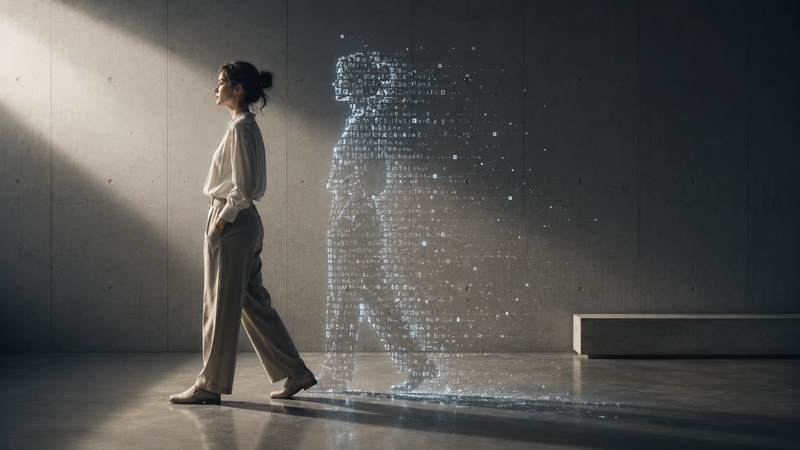
So the honest description was never a copied person, and it was never an alien intelligence either. It's a cast: human-shaped where we left impressions, hollow where we didn't. That's exactly why it feels uncanny. When it sounds eerily like someone, remember that it sounds like everyone. The average of every voice that ever wrote anything down.
And if you've ever posted, published, or typed a sentence in public, you were one of them. You've been leaving tracks your whole life.
Somewhere in the cast, a few of the fragments are yours.
Related in this series: The Majority Machine · The Equation of Meaning

Comments
No comments yet. Be the first to comment!