

The Cascade
Why Breakthroughs Will Stop Arriving One at a Time and Start Arriving in Waves.
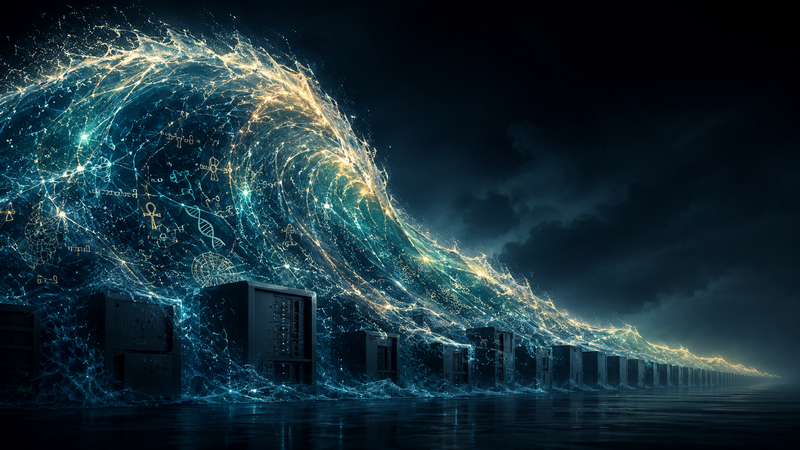

In the next five to ten years, more foundational discoveries will be made than in the previous five hundred. Not because humans suddenly got smarter. Because a seventy-year chain of tools, each one removing the barrier the last one revealed, just removed the final barrier. The one between humans and their own cognitive limits.
What follows isn’t one breakthrough. It’s a technological emergence cascade: a wave. Mathematics, physics, energy, biology, materials science. Fields that have been ripe for decades, some for centuries, all breaking open in the same window of time. Not because of AI. Because of what AI lets humans finally reach.
And the cascade doesn’t only move forward. It also moves backward, into ancient knowledge systems, lost mathematics, and encoded wisdom that’s been sitting in plain sight for millennia, waiting for tools sophisticated enough to recognize it as knowledge. The same cross-domain thinking that unlocks new physics also deciphers old understanding. We don’t just go forward faster. We go forward wiser, if we choose to.
And it won’t all come from the specialists. It will come from credentialed researchers in established institutions, yes. But it will also come from people with no formal academic background: autodidacts, independent researchers, outsiders who’ve been building deep cross-domain understanding for years without anyone’s permission or validation. People who see across fields because nobody told them they were only supposed to look at one.
The biggest gaps in human knowledge aren’t inside disciplines. They’re between them, in the spaces that nobody owns because academia siloed itself into departments that don’t talk to each other. The connections between physics and biology. Between ancient mathematics and modern computation. Between fields that look unrelated until someone who refused to stay in one lane sees the thread running through all of them.
Those people have always existed. They’ve always been the ones who trigger the biggest shifts. They just never had tools that could keep up with how they think. Now they do.
This is how we got here.
The Chain
Every generation of computing didn’t just make things faster. It removed a barrier. And the moment that barrier dropped, everything it had been holding back rushed through.
Mainframes. 1950s.
In 1952, a team at Los Alamos pointed a computer called MANIAC at a thermonuclear weapon design. The calculation would have taken a human mathematician years. The machine did it in weeks.
That was the moment: not when computers became useful, but when humans realized that problems they’d been unable to reach weren’t impossible. They were just waiting.
Nuclear physics, weather modeling, orbital mechanics, cryptography: entire fields that had been theoretically understood but computationally unreachable suddenly became practical. Apollo 11 was calculated on machines less powerful than a modern thermostat. The barrier was raw computation. Mainframes removed it. Discoveries that had been bottled up for decades poured through.
Personal Computers. 1980s.
Computing left the institution and entered the home. What previously required a university department now sat on a desk. A teenager in a garage could process what only a funded lab could process a decade earlier.
The barrier was access. PCs removed it. The software revolution, desktop publishing, early digital design, the birth of an entire industry of people building things with computation who never would have been allowed near a mainframe. All of it poured through the moment the barrier dropped.
Networks. Late 1980s.
Computers started talking to each other. Researchers could share findings without mailing paper. Collaboration that took months took days. BBS boards, university networks, ARPANET: still siloed, still limited, but a fundamentally different world from isolated machines doing isolated work.
The barrier was isolation. Networks removed it.
The Internet. Mid-1990s.
Everything connected. Every researcher, every dataset, every paper, all accessible from anywhere on Earth. The entire record of human knowledge began migrating to a single shared medium. Search engines meant you didn’t need to know where to look. You just needed to know what to ask.
The barrier was findability. The internet removed it. And the volume of what poured through was so large it created its own new problems, problems that the next barriers would eventually address.
Mobile. 2007.
Computing became continuous. Not something you sat down to do. Something you carried. Always on, always connected. The boundary between “using a computer” and “living your life” dissolved. Every human with a smartphone became both a source of information and a consumer of it, every waking moment.
The barrier was intermittency. Mobile removed it. And the world reorganized around the assumption of constant connectivity so quickly that within a decade, the previous world, the one where you could be unreachable, became almost unimaginable.
Cloud. 2010s.
Computational power became elastic. You didn’t need to own a supercomputer. You rented one by the hour. A five-person startup could access the same scale as a multinational corporation. Machine learning became practical not because the theory was new (much of it had existed for decades) but because the training infrastructure was finally available on demand to anyone willing to pay for it.
The barrier was scale. Cloud removed it.
AI. 2020s.
Every previous era removed a logistical barrier. How fast you could calculate. Who could access the tools. How quickly you could share results. How much data you could find. How continuously you could work. How much power you could access.
AI removes a different kind of barrier. Not logistical. Cognitive.
For the first time, the tool doesn’t just help humans do what they already do more efficiently. It helps them do something they physically couldn’t do before: hold the full complexity of multiple fields in view simultaneously and find connections across domains that no individual human mind has the bandwidth to see.
Every previous era took one wall down and revealed the next wall behind it. Computation revealed access. Access revealed isolation. Isolation revealed findability. Findability revealed intermittency. Intermittency revealed scale. Scale revealed the final wall: the limits of the human mind itself.
AI takes down that last wall.
And when the last wall in a sequence falls, what follows isn’t another incremental improvement. It’s everything the walls were holding back, arriving at once.
What’s Been Waiting
The breakthroughs coming aren’t emerging from AI. They’re emerging from fields that have been building toward thresholds for decades, sometimes centuries, waiting for a barrier to drop. AI didn’t plant these seeds. It’s the rain.
Mathematics.
In 2016, a researcher at Humboldt University was re-examining Babylonian clay tablets that had sat in the British Museum for over a century. What he found stunned the field: the ancient Babylonians had used a geometric method resembling integral calculus to track Jupiter’s motion, a technique historians had credited to fourteenth-century Oxford. The knowledge was there, on the clay, for thousands of years. Nobody recognized it because nobody expected to find it.
That pattern, knowledge waiting to be seen, defines where mathematics is right now. There are problems brilliant people have been staring at for a hundred years. Not because the problems are impossible. Because they require holding more structure in mind simultaneously than any human brain can manage. AI changes that. Systems are now generating novel proofs, verifying formal arguments at machine speed, and revisiting ancient mathematical traditions that turn out to contain structures everyone overlooked.
And here’s what mathematicians have long suspected but couldn’t demonstrate by working one problem at a time: the great unsolved problems aren’t independent. They’re connected. When one falls, it exposes structure that makes others vulnerable. Mathematics doesn’t advance one proof at a time. It advances in cascades. We’re approaching the conditions for one.
Physics.
Every major physics breakthrough in history followed a mathematical one. Newton needed calculus. Einstein needed Riemannian geometry. Quantum mechanics needed linear algebra and functional analysis. This isn’t a coincidence. It’s a dependency. Physics can only go where mathematics has already built a road.
The next physics is waiting for the next math. And the next math is arriving.
Here’s a number that should unsettle anyone who thinks we understand reality: ninety-five percent. That’s how much of the universe is made of things we cannot identify. Dark matter, at twenty-seven percent, has gravitational effects we can measure but can’t explain. Dark energy, at sixty-eight percent, is accelerating the expansion of space itself and we have essentially zero understanding of what it is. We built the Standard Model, confirmed the Higgs boson, and can describe the behavior of visible matter with extraordinary precision. And all of that accounts for five percent of what exists.
The next physics isn’t a refinement. It’s the discovery of what the other ninety-five percent actually is. When it arrives, enabled by mathematical tools we don’t fully have yet, it won’t just extend the current picture. It will replace it. And what that replacement unlocks, in energy, in materials, in our fundamental understanding of what reality is, will make the previous century of physics look like a prologue.
Energy.
Every energy technology humanity has ever used comes down to the same thing: exploiting a physical phenomenon we understand well enough to engineer. Fire. Steam. Electromagnetism. Nuclear fission. Each one transformed civilization. Each one was downstream of a physics breakthrough. No exceptions.
Fusion is approaching viability. Solar is already cheaper than fossil fuels. These matter. But consider how much we still don’t understand about energy at a fundamental level: quantum field theory predicts that so-called empty space, the vacuum, should contain energy. The discrepancy between what the theory predicts and what we observe is so vast it’s been called the worst theoretical prediction in the history of physics. That gap, between what our best models say should be there and what we can account for, is one of the deepest unsolved problems in science. The Casimir effect experimentally confirms that vacuum fluctuations exert real, measurable force. Something is happening in the space we call empty, and we don’t yet understand what.
The truly transformative energy breakthroughs aren’t about better solar panels or finally achieving fusion. They’re about closing the gaps in our understanding of physics itself, gaps so large that our best theories and our best observations disagree by dozens of orders of magnitude. When those gaps close, the energy landscape won’t just improve. The question won’t be how to generate enough energy. It will be what to do with what we find.
Biology.
Here’s a fact that should astonish anyone who thinks about information: the entire blueprint for a human being (trillions of cells, hundreds of tissue types, a brain with eighty-six billion neurons) is encoded in a molecule using four symbols. A, T, G, C. Four letters. That’s it. And for decades, scientists called ninety-eight percent of that code “junk DNA” because it didn’t directly code for proteins. We dismissed ninety-eight percent of the most sophisticated information system in the known universe as waste because we didn’t understand what it was doing.
We’re beginning to understand now. AI is mapping genetic mechanisms, discovering novel protein structures, and identifying functional roles for regions of the genome that were written off as noise, at a pace that would have seemed fictional five years ago. The gap between understanding a living system and being able to work with it is closing faster than anyone predicted.
This isn’t about replacing biology with technology. It’s about understanding life deeply enough to participate in it: to work with living systems at a level of nuance that respects their complexity rather than bulldozing it. The implications for medicine, for agriculture, for how long and how well humans live. These aren’t incremental improvements. They’re the beginning of an entirely different relationship between humanity and biology.
Materials.
Every major era of human civilization is named after a material. Bronze. Iron. Steel. We don’t call it the Bronze Age because someone had a good idea. We call it that because a new material unlocked capabilities that were literally inconceivable before it existed. You can’t imagine a transistor in a world without silicon. The concept requires the material to exist before the idea can form.
Here’s what most people don’t realize: we’ve barely explored the space of possible materials. The number of theoretically stable chemical compounds vastly exceeds the number we’ve ever synthesized. We’ve been limited to what we could discover by accident, intuition, or slow systematic experimentation. AI-driven simulation is now exploring that space at speeds that would have been unthinkable five years ago: testing millions of candidate structures for properties we specify, designing substances that don’t exist in nature for purposes we’re only beginning to imagine.
The next material revolution won’t just improve what we can build. It will expand what we can conceive of building. And like every material revolution before it, the capabilities it unlocks will be ones we literally cannot imagine from this side of the threshold, because imagining them requires the material to exist first.
History.
The cascade doesn’t only move forward. It also moves backward.
We are surrounded by ancient knowledge we never fully understood. Mathematical systems, astronomical records, engineering achievements, and encoded structures that have been sitting in museums, carved into stone, and buried in archaeological sites for thousands of years. Dismissed as mythology, catalogued as cultural artifact, or simply unrecognized as knowledge because we didn’t have the tools or the cross-domain perspective to see what they actually were.
That’s changing. The same tools and cross-domain thinking that are opening up mathematics and physics are being turned on the ancient record. And what’s emerging is not what the conventional story predicted. Astronomical precision that shouldn’t exist at the dates it appears. Mathematical structures embedded in architecture that predate their supposed discovery by centuries or millennia. Knowledge systems so sophisticated they were mistaken for religion because no one expected science from the people who built them.
We aren’t just going forward. We’re going backward, deciphering what was always there, recovering understanding that was lost or never recognized, so we can go forward smarter. Wiser. Carrying the accumulated insight of civilizations we’ve been underestimating since we first dug them up.
This is the part of the cascade that gives me genuine hope. The technological emergence isn’t just about new capabilities. It’s about reconnecting with old wisdom: deep structural understanding that was encoded in ancient systems by people who knew things we’re only now rediscovering. Speed without wisdom is the failure mode this entire series has documented. But the cascade offers something no previous threshold did: the chance to recover wisdom at the same time we develop capability. To learn from the full record of human understanding, not just the last few centuries of it, and carry that forward into what we build next.
Whether we take that chance is up to us.
The Convergence
Here’s what makes this moment different from every previous era of discovery. And it’s the part that’s hardest to convey, because we don’t have good intuitions for what it feels like when multiple exponential curves intersect.
These fields aren’t advancing on separate tracks. They’re feeding each other.
A mathematical breakthrough enables a physics insight. A physics insight enables a materials innovation. A materials innovation enables better computational hardware. Better hardware accelerates the next mathematical breakthrough. This cycle has always existed. It’s how progress has always worked. But the handoffs used to take decades. A generation of mathematicians would develop tools that the next generation of physicists would apply. The physicist’s grandchildren might see the engineering applications.
AI collapses the handoffs. Not to years. To months. The time between one field’s discovery and another field’s application of it is shrinking so fast that the fields are starting to advance in sync rather than in sequence. That’s never happened before.
And the intervals between computing eras tell the story. Mainframes to PCs: roughly twenty-five years. PCs to networks: about ten. Networks to internet: about five. Internet to mobile: about ten. Mobile to cloud: about five. Cloud to AI: about five.
Each transition arrives faster than the last, because each new tool accelerates the development of its successor. The tools are building the tools that build the next tools. That’s not a slogan. It’s what’s literally happening right now in AI research.
When the cycle time between breakthroughs drops below the time it takes to fully absorb the previous one, the breakthroughs stop arriving one at a time. They arrive in waves.
That’s not a prediction. That’s the pattern, extended one step. And if it makes you uneasy, it should. Because what comes next is either the most exciting or the most dangerous period in human history. Probably both.
The Humans
Here’s what gets lost in every AI narrative, every breathless forecast, every magazine cover about the robot future. And it’s the thing I care about most.
Every breakthrough still starts with a human who knows what question to ask.
AI can explore solution spaces at inhuman speed. It can verify proofs, simulate systems, and surface patterns across domains. What it cannot do, what it may never do, is know what matters. It doesn’t feel the weight of a question. It doesn’t carry twenty years of deep intuition about a field, the kind that knows which questions are worth asking before anyone can articulate why. It doesn’t wake up at 3am with a connection nobody else has seen, because nobody else has lived inside the problem long enough to dream about it.
That’s the irreplaceable thing. Not computation. Not speed. Not pattern matching. The human capacity to care about a problem so deeply that the problem starts to reveal itself. That’s not romantic language. Ask any researcher who’s ever had a genuine breakthrough. The answer didn’t come from working harder. It came from living inside the question long enough that the question changed shape.
The wave isn’t being ridden by AI. It’s being ridden by those humans: people who’ve spent years, sometimes lifetimes, building the kind of understanding that knows where to point the tools.
The mathematician who spent twenty years circling a problem and now has instruments precise enough to explore the solution space in days. The physicist who carried an intuition about a connection between fields and can now test it across the full landscape before lunch. The biologist who understood a system deeply enough to ask the question nobody else thought to ask, and now has the power to hear the answer.
These people aren’t being replaced by AI. They’re being unleashed by it. And that might be the most hopeful sentence in this entire series.
The ones who will drive the wave aren’t necessarily the ones with the most resources, the most credentials, or the most institutional support. They’re the ones with the deepest understanding. The ones who’ve been building knowledge for years without knowing what was coming. The ones who see across fields because they refused to stay inside one long enough to forget that the boundaries are artificial.
History is very clear on this point. The biggest breakthroughs don’t come from where the establishment expects. They come from patent clerks and self-taught mathematicians and people working alone who happen to see a connection everyone else walked past. Einstein was working in a patent office. Ramanujan had no formal training. Faraday was a bookbinder’s apprentice. The structure of DNA was pieced together by people from physics, chemistry, and biology who ignored the lines between their fields.
That pattern isn’t going to change. If anything, AI accelerates it, because the tools that amplify deep human insight are now available to everyone, not just those with institutional access. The playing field didn’t just level. It inverted. The outsider with deep cross-domain understanding and access to modern AI tools may be better positioned than the specialist inside an institution, because the outsider isn’t carrying the assumptions that come with disciplinary training. They’re free to ask the questions that departments were designed to prevent.
The wave won’t come from where you expect. It never does.
The Speed Problem
Now the weight. Because wonder without weight is just entertainment, and this isn’t entertainment.
This series has documented a pattern across four thousand years of history. Every time a new capability reorganized how power, information, or meaning flowed through civilization, and arrived before the wisdom to hold it, the consequences outlasted every benefit. Not sometimes. Every time.
The cascade is that pattern at a scale we’ve never faced. Not one threshold. Dozens, spanning mathematics, physics, energy, biology, and materials, arriving in the same window of time. Overlapping. Each one amplifying the others.
And the window for developing wisdom around each new capability is shrinking at the same rate the capabilities arrive. The printing press gave Europe eighty years before the wars of religion. Social media took fifteen years to erode shared reality, and we still haven’t built the governance to address it.
The cascade doesn’t offer fifteen years. The interval between breakthroughs is itself collapsing. Each computing era produced its own version of capability outrunning wisdom. And each time, we adapted eventually, messily, at cost. The damage was always real. The adaptation always lagged by years or decades.
Now multiply that lag by every ripe field breaking open at once.
The seven principles from the first article in this series weren’t derived for a world where one threshold arrives per generation. They were derived for this: a world where multiple thresholds cross simultaneously and the time to develop wisdom for each one approaches zero.
What Follows
Not prediction. Pattern recognition. And, if I’m being honest, something closer to awe, tempered by everything this series has documented.
The breakthroughs will be genuinely wonderful. Problems that have plagued humanity for centuries (disease, energy scarcity, environmental destruction, the limits of the human body and mind) are approaching solutions. Not someday. Not in the abstract. Within years. The fields are ripe. The tools have arrived. The people who will make the connections are already working. Some of them are people you’ve never heard of. That’s the point.
And the breakthroughs will carry genuine danger. Not because knowledge is evil. Not because discovery is reckless. Because the pattern, six for six with no exceptions, says that capability without structural wisdom produces consequences that outlast every benefit. Every single time.
The same discoveries that cure diseases will create new categories of biological risk. The same energy breakthroughs that end scarcity will destabilize every power structure built on scarcity. The same tools that augment human intelligence will create influence capabilities that make the Personality Perception Fingerprint from article three look primitive. The same understanding that opens the universe will demand a maturity we haven’t yet demonstrated.
The wave carries both simultaneously. The wonderful and the dangerous arrive together, because they’re the same breakthroughs viewed from different angles. You don’t get to choose which discoveries show up. They come together. Always have, always will. The printing press opened every door at once. The atom split for energy and for cities in the same decade. Social media connected the world and fractured it with the same feature set.
This isn’t pessimism. It’s the pattern, applied honestly to what’s coming. And the pattern says the question is never whether the breakthroughs arrive. The question is whether the wisdom architecture exists when they do.
The Window
There is a window right now. Brief. Maybe a few years. While the wave is building but hasn’t fully broken.
In that window, the structural requirements from this series (the seven principles, the cognitive depth architecture, the awareness of what deep understanding means for human autonomy) can still be built into the foundation of what’s coming. Not as afterthoughts. Not as regulations drafted after the damage is done. As engineering requirements, built into the systems at the architectural level, before the systems become too embedded to redesign.
After the window closes, after the wave breaks and the cycle time between breakthroughs drops below the time needed to develop governance for any single one of them, the principles become commentary. Interesting to discuss. Impossible to implement in time. History written by people explaining what should have been done.
Every previous threshold in this series had a window. The printing press had a window before the wars of religion. Nuclear weapons had a window before proliferation. Social media had a window before the engagement algorithms were locked in. Every time, the window closed before the wisdom was ready. Not because the wisdom didn’t exist. Because it wasn’t treated as an engineering requirement. It was treated as philosophy: interesting but optional, important but not urgent, someone else’s job.
The seven principles are not philosophy. They’re structural requirements, derived from the accumulated record of what happens when they’re absent. And the cascade is the test of whether deriving them in time makes any difference.
Where Will You Be?
We used to talk about “surfing the internet.” It meant browsing. Clicking. Drifting from page to page with no particular destination. It was passive. The internet rewarded you just for showing up. You didn’t need a plan. You didn’t need depth. You just needed a connection and some free time.
This wave is different. AI doesn’t reward aimless consumption the same way. The people who benefit most aren’t the ones who use it casually. They’re the ones who bring something to it. A question worth asking. Understanding deep enough to recognize a meaningful answer. Purpose. The tools are extraordinary, but they amplify what you bring. Show up empty, you leave with noise. Show up with years of deep thinking, and the tools finally let you reach what you’ve been circling.
Surfing the internet was floating. Surfing this wave takes skill, direction, and intent.
The technological emergence cascade is a vehicle. It’s already moving. Everyone is in it. That part isn’t optional. What’s optional is where you sit.
Driver’s seat. You’re building. Discovering. Steering. You see the road before anyone else because your hands are on the wheel. You chose the direction, or at least you’re fighting for it. The view is clearest here. So is the responsibility. The weight of every decision lands on you first.
Shotgun. You’re not steering but you’re watching the road. You see what’s coming almost as soon as the driver does. You’re contributing: navigating, interpreting, translating breakthroughs for the people behind you. You chose to sit up front. You have access to the conversation that shapes the direction. The ride is rougher here than in the back, but you know where you’re going and why.
Backseat. You’re along for the ride. Comfortable enough. You’ll benefit from the destination when you arrive. But you didn’t choose the route and you’re not watching the road. By the time you react to a turn, it already happened. The view is limited to the windows on your side. You experience the journey, but the journey isn’t shaped by you. Most people are here, not by decision, but by default. Because they never realized there was a front seat open.
Third row. You barely know you’re in a vehicle at all. The world shifts around you and you experience it as things happening to you: changes you didn’t anticipate, disruptions you can’t contextualize, a destination you never agreed to. The seats are smaller back here. Less room. Less comfort. Fewer options. Less access to the controls, to the conversation, to the view. By the time information reaches the third row, the decisions it relates to were made miles ago.
Right now, today, everyone is choosing their seat. Not by a single dramatic decision. By what they pay attention to. By whether they engage with what’s coming or let it arrive unexamined. By whether they build understanding or wait for someone else to summarize it.
Failure to choose is the third row while the vehicle drives the future.
One More Thing
I’ve written this series as analysis. Historical derivation. Architectural diagnosis. Pattern recognition applied to what’s coming. The tone has been deliberately measured: an observer examining evidence, drawing conclusions, presenting them for consideration.
I need to break that frame.
I’ve spent this series writing as if I’m watching the wave from shore. I’m not.
I’m an independent researcher with no institutional affiliation, no academic credentials in the fields I work in, no lab, no funding beyond what I generate myself. I work from a small room in Texas with a laptop and a dog named Candy. I work with AI every day, not as a novelty, not as a writing assistant, but as the kind of discovery tool this article describes. The instrument that finally keeps pace with how I think. The thing that lets me test connections across fields that I’ve been circling for years but couldn’t reach without it.
The cascade is real. The wave is building. The fields are ripe and the tools have arrived and the people who will break things open are already at work: credentialed and not, funded and not, visible and not.
Some of us have been waiting a long time for the tools to catch up.
We are here now.
The only question left is the one this series has been asking from the beginning. And it’s no longer abstract, no longer theoretical, no longer someone else’s problem.
Will we be ready?

Comments
No comments yet. Be the first to comment!