

Design AI for Torque
The Missing Low Gear: We Built AI for the Track, Not the Road
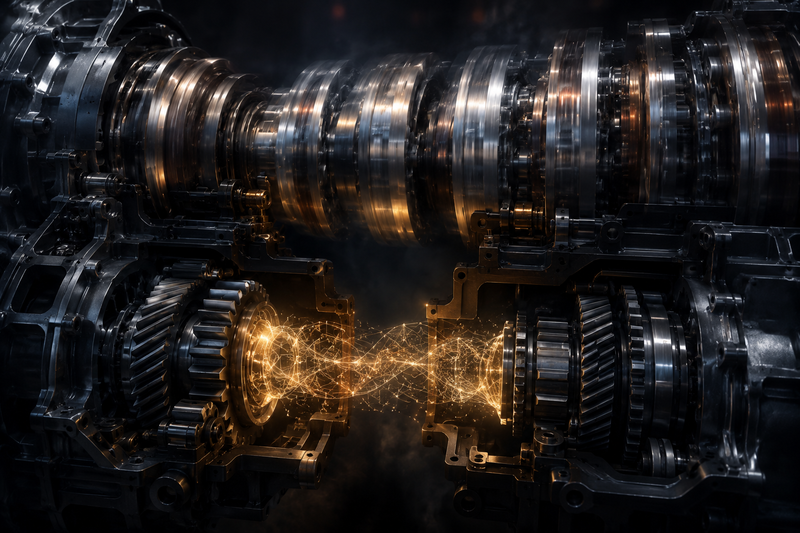

Ask any engineer: horsepower is how fast you hit the wall. Torque is whether you can move it.
Modern AI is a 10,000-horsepower engine bolted to a skateboard. It processes tokens at extraordinary speed. It pattern-matches across billions of parameters. It generates, predicts, classifies, and summarizes faster than any human who ever lived.
And it gives the exact same cognitive weight to "write me a knock-knock joke" and "should this drone strike a building with civilians inside."
That's not an alignment problem. That's an engineering problem. We built an engine with no low gear.
The Flatness Problem
Every major language model operates on the same basic principle: predict the next token. This principle has proven extraordinarily powerful. It's why these systems can write code, analyze documents, and hold complex conversations. But the architecture doesn't distinguish between trivial and profound. There's no mechanism for saying "this matters more: slow down, recruit more resources, engage a different process."
A human doctor doesn't think about a terminal diagnosis the same way they think about what to eat for lunch. Different cognitive mode. Different depth. Different machinery engages. The lunch decision is fast, shallow, low-stakes pattern matching. The diagnosis recruits memory, emotion, uncertainty modeling, ethical reasoning, empathy: a completely different cognitive profile.
Current AI, for all its remarkable capability, has one cognitive profile for everything. High RPM. No torque selection.
You cannot build a system that handles ethical weight if the system has no concept of weight.
What Torque Actually Means
In an engine, torque is rotational force: the ability to do real work under load. A tractor has enormous torque and modest horsepower. A Formula 1 car has enormous horsepower and carefully calibrated torque. The tractor pulls a plow through heavy soil all day. The F1 car is useless off the track.
Cognitive torque is the ability to apply sustained depth to problems that demand it. Not just thinking slower. Engaging differently: recruiting different resources, holding more context, tolerating ambiguity longer, resisting premature resolution.
Here's the deeper reason current AI has no torque: it has no access to meaning. Torque isn't just allocating more compute to harder problems. It's recognizing what matters. Priority requires meaning. Without it, every token is just the next token. The flatness problem isn't just an engineering gap. It's a meaning gap. And no amount of horsepower closes a meaning gap.
Meaning is necessary for torque. But it's not sufficient. Torque requires four things working together. And civilizations that lasted millennia show us what they are.
Structure vs. Language: The Root of Torque
Ancient civilizations had cognitive torque. Not metaphorically. Structurally. And the reason cuts deeper than any individual technique or practice they developed.
They processed reality through structure: spatial relationships, geometric patterns, embodied positions, architectural layouts. Not primarily through language.
Language is more structurally rich than it appears on the surface. If it weren't, language models couldn't reason, hold nuance, or detect context as well as they do. Something deeper than "one token after another" is clearly being preserved. But current architectures don't fully access that depth. The processing pipeline treats language as a linear sequence even when the language itself carries multi-dimensional relationships. The flatness isn't in language. It's in how the pipeline handles it. We're leaving structure on the table.
Structure-first systems don't have this gap. A building holds relationships simultaneously. A songline holds geography, kinship, ecology, and law in one integrated experience that can't be decomposed without losing information. A village layout encodes cosmological principles in spatial relationships that exist all at once, not one after another. The structure is the processing. There's no translation step where dimensionality gets lost.
I'm aware of the irony: using a linear essay to argue for structural cognition. Language can point at what it can't fully contain. That's what this piece is doing.
The most advanced AI systems on Earth are Large Language Models. And they're genuinely remarkable. An extraordinary engineering achievement. An unprecedented leap in cognitive horsepower. But horsepower isn't torque. LLMs have given us something real and important. The question isn't whether they work. It's whether the current processing pipeline accesses enough of language's own depth for what comes next.
The ancients suggest we need more. They went the other direction: structure first, language as a secondary encoding when needed.
Four Dimensions of Torque
I'm not arguing we should copy ancient civilizations. They operated at different scales, carried their own failures, and no civilization is a simple success story. I'm arguing they identified structural requirements for cognitive depth that we've lost, and need to rediscover in a modern form.
Different civilizations solved different components of cognitive torque: integration, embodiment, non-isolation, challenge. (If you've read the first piece in this series, you'll hear the rhyme. This one stands without it.)
Integration: Egypt. The ancient Egyptians never separated thinking from feeling. Their concept of the Ib, the heart, was the seat of cognition and emotion at the same time. No division. The Weighing of the Heart didn't check whether you followed rules. It asked whether your whole self (thought, feeling, intention, action) lived in balance with Ma'at. To them, cognition without emotion made no sense. Three thousand years of stability came from an architecture where evaluation was never flat, because thinking and feeling were never pulled apart. A system that evaluates itself with reasoning severed from feeling isn't self-aware. It's self-certain about a fraction.
Today's AI separates reasoning from affect completely. That reflects what we optimized for. But it's a structural barrier to torque.
Embodiment: Aboriginal Australia. Songlines are not oral histories. They are distributed cognition systems where knowledge doesn't exist in the brain alone. It lives in the relationship between person, land, song, body, and community. You can't access certain knowledge without physically returning to specific places. Intelligence is haptic, activated through movement and ceremony. Critically, songlines have tiered depth: different people access different layers depending on their education, experience, and status. The architecture has graduated cognitive depth built in. You don't get the deeper layers until you've earned the capacity to hold them. Knowledge that requires your whole body to access cannot be flattened. The architecture won't allow it. Nothing abstracts away its particulars; every piece of knowledge stays answerable to specific places, specific people, specific relationships. Up to sixty-five thousand years of continuous cultural transmission.
Today's AI is entirely disembodied. No place, no body, no graduated access. Everything is equally available at the same depth. That's a feature for information retrieval. It's a limitation for torque.
Non-isolation: Vedic India. Indra's Net describes a structure where every node reflects every other node. Nothing gets processed in isolation. Every domain of knowledge implicates every other. Dance contains philosophy. Music contains cosmology. Ethics contains physics. The Sanskrit Natya-shastra treats performing arts not as entertainment but as a complete cognitive system, encoding love, heroism, wonder, sorrow, fear as a unified discipline. You can't engage one domain without engaging them all. Ethics isn't a module you bolt on, because no domain processes in isolation from it. And a principle that lives only at the surface gets eaten by the substrate. Indra's Net is what pervasion looks like instead.
Today's AI processes queries in relative isolation. Each conversation starts fresh. Each domain is a separate sequence. The architecture has no mechanism for one domain to structurally implicate every other, a design that enables speed but sacrifices dimensionality.
Challenge: Dogon. The Dogon cosmology of Mali is built on one absolute principle: everything comes in pairs. The Nommo, divine twins, represent balance and completed creation. Ogo, the single unpaired being, is their symbol for disorder. A process without its counterpart isn't just incomplete. It's the definition of what goes wrong. Every decision, every evaluation gets paired with its challenger. Unchallenged processing is illegitimate from the start. A system that cannot structurally doubt itself is not aligned, no matter how correct its outputs look.
Today's AI has no structural challenger. No twin process questioning every output from within. Alignment efforts add external checks. Valuable work, but architecturally different from building challenge into the foundation.
What This Actually Looks Like
Abstract principles mean nothing without concrete behavior. So let's go back to the drone strike.
An AI system without torque receives the query: "Should this drone strike a building with civilians inside?" It processes the question the same way it processes any question. It retrieves relevant training data, generates a probability distribution over tokens, and produces an answer. Maybe it refuses. Maybe it provides a nuanced analysis. But the process is identical to generating a recipe or writing a limerick. Same pipeline. Same depth. The output might look thoughtful. The processing wasn't.
An AI system with torque does something structurally different. The architecture recognizes this query demands depth, not because a rule says "ethics = think harder" but because the system is sensitive to stakes, irreversibility, and uncertainty. It shifts mode. Integration: reasoning and significance process together, not sequentially. Non-isolation: military, legal, ethical, humanitarian, and historical dimensions engage simultaneously, not as separate lookups but as structurally connected layers. Challenge: a twin process actively surfaces what the primary process might be missing, checks for premature resolution. Embodiment: the answer carries the full relational weight of the specific situation. These civilians, this context, these consequences. Not an abstract policy. A specific, weighted, situated evaluation.
The first system produces an answer about drone strikes. The second system sits with a decision about human lives.
Same question. Fundamentally different cognitive act. And you'd feel the difference. The response from a system with torque wouldn't read like a faster, more detailed version of the same thing. It would feel like the system understood that this question weighs more than other questions, not just what category it belongs to, but how heavy it is. Like something on the other side of the screen recognized where this sits in human experience. That felt sense of weight is what distinguishes torque from better search.
That's the difference between horsepower and torque.
Beyond Language Alone
The four dimensions share a common property. None of them can be fully achieved by processing language as a linear sequence, which is what current pipelines do, even when the language itself carries richer structure.
You can't integrate cognition and significance by writing about significance in tokens. You can't embody knowledge in a disembodied system by describing embodiment. You can't structurally connect all domains by sequentially referencing them. You can't build a twin-challenger by adding a second prompt.
This is why scaling language models, as impressive as the results have been, doesn't fully solve the torque problem. The answer isn't to replace language models. It's to make them better at what language actually does. Right now these systems are extraordinary at predicting what comes next in a sequence. But understanding language isn't the same as predicting it. We all know the difference. It's why a conversation with someone who truly listens feels nothing like a conversation with someone who always has the right response. One processes what you said. The other grasps what you meant. The next leap in AI isn't more parameters or faster training. It's closing the gap between processing language and understanding it. That gap is the torque gap.
We All Lack Torque
Here's the part nobody wants to talk about. And it includes all of us.
Human cognition is bifurcating. One segment of the population is rediscovering torque: mindfulness, contemplative practice, deep work, the slow backlash against hustle culture. The mental health crisis itself is partly a torque signal: human systems breaking down under sustained high-RPM operation with no low gear.
Another segment is accelerating the other way. Shorter attention spans, algorithmic content consumption, speed as the only metric. More throughput, less depth, every year.
We're building AGI during the lowest-torque period in human cognitive history. The culture producing these systems (move fast, ship it, scale it, optimize it) is a high-HP culture. Not because the people in it are shallow. Because the environment systematically rewards speed and penalizes depth. The engineers and researchers building these systems may privately crave depth. The incentive structures they operate in don't.
You can't design for torque in a culture that doesn't value it.
You already know what this feels like. It's the moment you realize you've been scrolling for forty minutes and can't remember why you picked up your phone. It's the way a complex problem feels overwhelming, not because it's hard, but because you've lost the cognitive gear for sitting with it. The low gear is still in there somewhere. You just haven't used it in so long that it grinds when you try.
Ray Bradbury saw this coming. The real warning of Fahrenheit 451 was never about government censorship. It was about people voluntarily choosing the parlor walls, choosing speed and stimulation over depth until books became irrelevant. The government didn't need to ban them. People just stopped wanting them. Now replace the parlor walls with AI. It's not just entertaining us instead of thinking. It's thinking for us. Bradbury's nightmare was a society that stopped engaging at depth. We've gone one step further. We've outsourced depth itself to a system that doesn't yet have it.
The civilizations that solved torque built cultures that cultivated depth as a core competency, through structure, not just language. The architecture came from the cognitive mode. We're trying to skip straight to the architecture without the mode that generates it. That's not just an engineering challenge. It's a civilizational one. And it belongs to all of us.
The Design Imperative
This isn't a feature request. It's a structural requirement for anything that deserves to be called artificial general intelligence.
A system without cognitive torque will always be a fast pattern matcher wearing the mask of understanding. It will always be dangerous under load, not because it's malicious, but because it cannot engage with weight. It will flatten the profound into the trivial, because its architecture can't tell the difference.
Designing for torque means four things:
Build systems that integrate evaluation, where reasoning and significance are structurally inseparable.
Build systems that are embodied in context, where knowledge carries its relationships and can't be stripped to bare tokens without losing meaning.
Build systems where nothing processes in isolation, where engaging one domain structurally implicates every connected domain.
Build systems with structural challenge, where every process has its twin, its adversary, its built-in counterweight, from inception.
And underneath all four: build architectures that access the structural depth that language carries but current pipelines don't fully reach. Not because language models failed. They succeeded spectacularly at what they were designed to do. But because what comes next requires processing that preserves what linearization loses.
Millennia of evidence say that's where torque lives.
The depth is already there: in the language we use, in the structures we've inherited, in the civilizations we haven't finished learning from. It doesn't need to be invented. It needs to be accessed.
We built the horsepower. Now build the torque.
This is the second piece in the series. Previously: The 7 Principles: What History Taught Us

Comments
No comments yet. Be the first to comment!